
If an Information Security Management System is built on the wrong assumptions, everything that follows becomes weaker. Risks get misjudged, controls end up in the wrong places, and decisions about scope start to feel arbitrary. That is why Chapter 4 carries so much weight. Before you can do anything else in ISO 27001, you need to understand the environment your ISMS is going to operate in, who has a stake in it, what it actually covers, and how the management system itself is structured. Clauses 4.1 through 4.4 walk you through each of those steps.
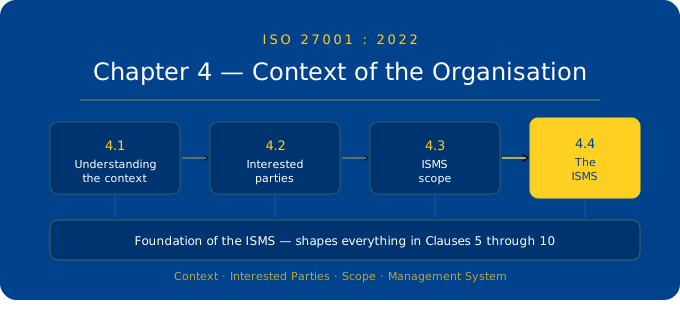
In practical terms, Clause 4 is really asking a handful of fundamental questions. What kind of organisation are we? What internal and external conditions shape our security needs? Who expects something from us, and what do they expect? What is inside the ISMS, and what sits outside it? Until those questions have honest answers, the rest of the standard cannot be applied in any meaningful way. ISO 27003 makes the point clearly: this analysis helps determine scope, supports risk and opportunity planning, and keeps the ISMS aligned with conditions that will inevitably change over time.
4.1 Understanding the Organisation and Its Context
Clause 4.1 requires the organisation to identify the external and internal issues that are relevant to its purpose and that could affect its ability to get the ISMS to do what it is supposed to do. This is not a box-ticking exercise. It is about genuinely understanding the environment in which information security has to function. ISO 27003 explains that this analysis serves three clear purposes: deciding the ISMS scope, determining risks and opportunities, and making sure the ISMS can adapt as conditions around it change.
Internal issues cover a wide range of things: organisational culture, governance structures, roles and responsibilities, existing policies, available resources, physical infrastructure, information systems, how information flows through the business, and even what previous audits or risk assessments have surfaced. External issues bring in the wider world: legal and regulatory developments, market pressures, technology trends, competitive dynamics, and physical or environmental conditions. These examples are not an exhaustive checklist but will vary from one organisation to the next.
That variation is exactly the point. A heavily regulated healthcare provider, a small software company, and a multi-site manufacturing business do not share the same context, and their ISMS should not look the same either. If your analysis is shallow or treated as a formality, the ISMS will reflect that. It will be disconnected from the real business; wrong controls may be selected and the
decisions that flow from it become harder to justify and harder to defend in audits.
From a documentation perspective, clause 4.1 does not explicitly require a dedicated document. ISO 27003 clarifies that documented information for this activity is mandatory only in the form and to the extent the organisation determines necessary for the effectiveness of the management system, as referenced under 7.5.1. In plain terms, the standard requires the activity to happen, but it does not prescribe a specific named document to capture it.
That being said, many organisations typically record this work somewhere. Common examples include a context register, workshop minutes, a business environment summary, risk workshops outputs, management meeting minutes where these issues were discussed and agreed upon.
Whatever form or forms you use; the important part is that the analysis is genuine and traceable.
When it comes to audit evidence, an auditor reviewing 4.1 will be looking for signs that the organisation has genuinely engaged with this question rather than simply ticked a box. Useful evidence can include documented lists of internal and external issues, records of leadership discussions, strategy documents, business plans, organisational charts, risk workshop outputs, and interviews with management that demonstrate a real understanding of how the operating environment shapes the ISMS. ISO 27003 also notes that the results of 4.1 feed directly into 4.3, 6.1, and 9.3, so auditors will often test for consistency across those later activities as well. If the context analysis says the organisation operates in a heavily regulated industry but the risk assessment and controls show no sign of that, the disconnect will be noticeable.
4.2 Understanding the Needs and Expectations of Interested Parties
Clause 4.2 requires the organisation to determine which interested parties are relevant to the ISMS, what their relevant requirements are, and which of those requirements will be addressed through the ISMS. ISO 27001 specifically notes that these requirements can include legal and regulatory requirements as well as contractual obligations. ISO 27000 defines an interested party as a person or organisation that can affect, be affected by, or perceive itself to be affected by a decision or activity.
That definition is broader than many people initially expect. Information security does not exist in a vacuum, and the expectations placed on an ISMS come from many directions at once. Customers may expect confidentiality commitments. Regulators may impose legal requirements that carry real consequences if they are not met. Shareholders may expect resilience and continuity. Employees may expect that their data is handled responsibly and that the systems they depend on are secure. Suppliers may require clearly defined interfaces and responsibilities before they are willing to share sensitive information. ISO 27003 gives examples of both external and internal interested parties, including regulators, shareholders, suppliers, customers, top management, process owners, support functions, employees, and information security professionals. The list will look different for every organisation, which is precisely why this clause requires each organisation to work it out for itself rather than applying a generic template.
The purpose of clause 4.2 is to turn vague expectations into concrete requirements. Once those requirements are identified and understood, they start to influence a great deal of what comes later in the ISMS. They shape scope decisions, feed into risk planning, inform the selection of controls, drive compliance activities, and help define what the ISMS needs to demonstrate to the outside world. An organisation that skips this step or treats it superficially will often find itself surprised later when a customer audit, a regulatory inspection, or a contract review surfaces requirements the ISMS was never designed to address.
As with clause 4.1, the standard does not explicitly state that 4.2 requires a specific standalone document. ISO 27003 again explains that documented information on this activity is mandatory only in the form and to the extent the organisation determines necessary for ISMS effectiveness under 7.5.1 b). The standard requires the activity, but it does not prescribe one named document for it.
In practice, many organisations maintain legal and contractual requirements register, a compliance obligations register, an interested parties matrix, or a combined context and obligations document that covers both 4.1 and 4.2 together. These are often genuinely useful tools, even though clause 4.2 does not name them as mandatory. The value is not in having the document for its own sake but in having a clear, maintained record that the organisation actually knows who its interested parties are and what is expected of it.
Audit evidence for 4.2 can include the register itself, contract review records, legal requirement inventories, customer security requirements, supplier agreements, internal policy expectations, and interviews with management demonstrating that the right people understand which interested parties matter and why. An auditor will often go one step further and test whether the requirements identified in 4.2 actually show up later in the ISMS. If a significant customer requirement or regulatory obligation has been captured in the interested parties register but then disappears entirely from risk treatment, objectives, scope, or control selection, that inconsistency is likely to attract attention.
4.3 Determining the Scope of the Information Security Management System
Clause 4.3 is where the organisation defines the boundaries and applicability of the ISMS. To do that properly, it must consider the internal and external issues identified in 4.1, the requirements gathered in 4.2, and the interfaces and dependencies between its own activities and those carried out by other organisations. Unlike 4.1 and 4.2, this subclause carries a clear and explicit documentation requirement: the scope shall be available as documented information. There is no flexibility on that point.
This is one of the most consequential decisions an organisation must make when setting up their ISMS. The scope determines where the management system applies, and therefore where risk assessment, control selection, internal audit, management review, and improvement activities must all operate. Get the scope wrong and everything built on top of it is compromised. ISO 27003 is direct about this: if scope is unclear, risk assessment and treatment will not produce valid results. It also makes the point that interfaces and dependencies with other organisations are critical considerations, and that changes to scope after the ISMS has been established can create significant extra effort and cost. It is much better to get this right at the beginning.
The purpose of Clause 4.3 is precision. A scope that is too broad can become unmanageable, spreading resources and attention too thin to be effective. A scope that is too narrow can become artificial, failing to cover the information flows, systems, or dependencies that actually matter to the business. Neither serves the organisation well, and neither will hold up well under scrutiny. The scope needs to reflect reality: what the organisation actually does, where it does it, and how its information assets and processes connect to the wider world.
Because the scope is the one piece of documented information explicitly required by Clause 4, it deserves careful attention. It should clearly describe the organisational, physical, and technological boundaries of the ISMS, along with the relevant interfaces and dependencies. ISO 27003 is specific about what that description should cover: organisational scope with its boundaries and interfaces, ICT scope with its boundaries and interfaces, and physical scope with its boundaries and interfaces. A scope statement that vaguely refers to "all information assets" without specifying what that means in practice is unlikely to satisfy an auditor or serve the organisation particularly well.
Implementation evidence for 4.3 can include an approved scope statement, network and system boundary diagrams, process maps, site lists, service descriptions, outsourcing maps, and where relevant, descriptions of areas that have been excluded from scope along with the justification for excluding them. That last point is worth emphasising. Exclusions are not inherently a problem, but they need to be thought through and documented. An auditor will want to understand why something sits outside the scope and whether that decision is defensible given the context and the requirements identified earlier.
Audit evidence will typically focus on a few key questions. Does the scope genuinely reflect the context identified in 4.1 and the requirements from 4.2? Were interfaces and dependencies with other organisations properly considered? And perhaps most importantly, is the ISMS actually implemented throughout the stated scope in practice, rather than just on paper? A scope that claims to cover three sites but where two of those sites show no evidence of ISMS activity will be a significant finding.
4.4 Information Security Management System
Clause 4.4 requires the organisation to establish, implement, maintain, and continually improve an information security management system, including the processes needed and their interactions, in accordance with the standard. It is a short clause in terms of text, but broad in terms of what it means. Its role is to connect everything in Clauses 4 through 10 into one functioning system rather than a collection of isolated activities.
The purpose of 4.4 is to make clear that ISO 27001 is not simply a checklist of controls or a folder of documents, but a management system in the full sense of the word. ISO 27000 defines a management system as a set of interrelated or interacting elements used to establish policies, objectives, and processes to achieve those objectives, and it defines a process as a set of interrelated or interacting activities that transforms inputs into outputs. Taken together, those definitions set a meaningful bar. Clause 4.4 requires an ISMS that operates as a living, connected system of processes rather than a set of disconnected security tasks that happen to share a label.
That distinction matters more than it might initially appear. Many organisations have security policies, risk registers, and control frameworks that exist largely in isolation from one another. Documents get produced, filed, and forgotten. Risk assessments may happen once and are never revisited. Incidents are resolved without feeding anything back into planning. That kind of approach might look like an ISMS from the outside, but it is not one in any meaningful sense. Clause 4.4 is the clause that demands otherwise. It requires the processes to actually interact, the outputs of one activity to become the inputs of another, and the whole system to be maintained and improved over time rather than simply being set up and left alone.
Clause 4.4 does not create a specific standalone documentation requirement of its own. In practice though, evidence for this clause tends to be spread across the entire management system. Policies, objectives, risk assessment and treatment processes, procedures, performance reports, audit outputs, and improvement records all contribute to demonstrating that a functioning ISMS exists. ISO 27003 notes that Clause 4.4 effectively requires the organisation to ensure that all the elements needed to establish, implement, maintain, and continually improve the ISMS are in place and working together.
Implementation evidence can include a process map or interaction map showing how the core ISMS processes connect, governance arrangements, clearly assigned responsibilities, operating procedures, and any overarching ISMS documentation the organisation chooses to maintain such as an ISMS manual. The key word here is chooses. An ISMS manual is not required by the standard, but some organisations find it a useful way to describe how the system hangs together.
Audit evidence for 4.4 is perhaps the most interesting of all the subclauses in Chapter 4, because the best evidence is not a single document. It is the functioning of the whole ISMS itself. An auditor will look for proof that risks identified in planning are actually being treated in operation, that performance is being reviewed, that internal audit is happening and producing useful outputs, and that nonconformities and improvement opportunities are being tracked and acted upon. If those things are happening consistently and systematically, Clause 4.4 is being met. If they are not, no amount of documentation will compensate for that.
Documentation, Implementation, and Audit Evidence Summary for Clause 4
If you look strictly at ISO 27001, clause 4 has one explicit documented information requirement: the ISMS scope under 4.3. The activities in 4.1, 4.2, and 4.4 are all mandatory, but the standard does not prescribe a named mandatory document for each of them. ISO 27003 reinforces this by explaining that documented information for 4.1 and 4.2 is mandatory only to the extent the organisation determines necessary under 7.5.1.
That does not mean organisations should avoid documenting clause 4. Quite the opposite. In practice, useful evidence often includes a context analysis or issue register for 4.1, an interested parties and requirements register for 4.2, a formally approved scope statement for 4.3, and some form of process or governance description to help demonstrate 4.4. The key point is that these documents earn their place because they make the ISMS clearer, more consistent, and more auditable, not because every one of them is individually named as mandatory in clause 4.
Why Clause 4 Matters in Practice
Clause 4 is often underestimated because it appears early in the standard and contains relatively little text. But in reality, it shapes everything that follows. Planning in clause 6 explicitly depends on the issues identified in 4.1 and the requirements gathered in 4.2. ISO 27003 is clear on this: the results of 4.1 feed into 4.3, 6.1, and 9.3, while the results of 4.2 feed into 4.3 and 6.1. If clause 4 is weak, the later clauses tend to become generic and disconnected from the business, and that weakness has a way of surfacing at the worst possible moments, such as during a certification audit or a customer security review.
A mature organisation treats Clause 4 as the point where information security becomes genuinely business aligned. It is where leadership begins to define what matters, what must be protected, which expectations must be met, and where the ISMS truly starts and ends. When done properly it gives the rest of the management system a solid, credible foundation to build on. Done poorly, or skipped over in a rush to get to controls and documents, it leaves everything that follows standing on uncertain ground.
That is why Clause 4 is not merely administrative groundwork. It is the basis on which the entire ISMS stands.