
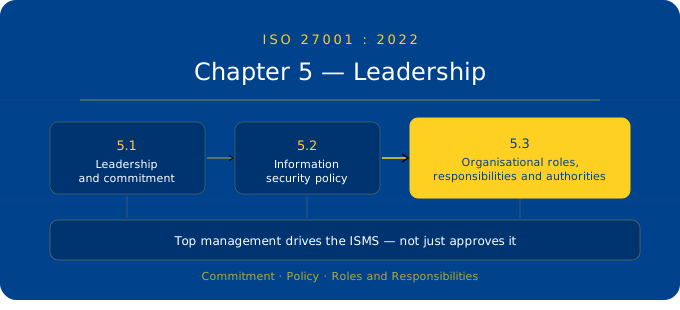
Clause 5 places leadership at the centre of the Information Security Management System. It requires top management to do more than approve documents. They must actively direct, support, and sustain the system so that information security becomes part of how the organization is managed in practice. ISO 27001 presents Clause 5 as three connected areas: leadership and commitment, policy, and organizational roles, responsibilities, and authorities.
An Information Security Management System does not begin with technology. It begins with leadership. Many organizations are tempted to treat information security as a specialist subject that can be delegated entirely to IT, compliance, or an external consultant. Clause 5 of ISO 27001 firmly rejects that idea. The standard makes clear that top management must demonstrate leadership and commitment with respect to the Information Security Management System. In other words, security is not meant to sit at the edge of the business or as some sort of afterthought. It must be directed from the top and embedded into the organization’s purpose, priorities, and decision-making processes.
This matters because an ISMS is a management system, not just a set of technical safeguards. ISO 27000 describes information security as the preservation of confidentiality, integrity, and availability of information, and the standard states that adopting an ISMS is a strategic decision for an organization. That means leadership is not a decorative requirement. It is the mechanism that turns information security from scattered activities into a coordinated, risk-based system. Without visible leadership, policy becomes a paper exercise, responsibilities become vague, and improvement quickly stalls.
Why Leadership Is Central to ISO 27001
Clause 5 places leadership at the heart of the standard because the Information Security Management System cannot function effectively without direction from the top. Information security touches governance, risk, resources, accountability, and culture. It is not enough for management to approve documents and leave implementation to others. The standard expects leadership to shape priorities, provide support, and ensure that information security is woven into the organization’s everyday operations.
Clause 5.1, Leadership and Commitment
Clause 5.1 requires top management to demonstrate leadership and commitment by ensuring that the information security policy and objectives are established and aligned with the strategic direction of the organization, by integrating ISMS requirements into organizational processes, by making resources available, by communicating the importance of effective information security management, by ensuring the ISMS achieves its intended outcomes, by directing and supporting people, by promoting continual improvement, and by supporting other relevant management roles in their own areas of responsibility. This is one of the most important passages in the standard because it shows that leadership is expected to be active, not symbolic.
In practical terms, this means information security must be connected to how the organization actually operates. It should influence planning, project decisions, budgeting, governance, supplier management, and performance review. ISO 27003 explains that top management has overall responsibility for the ISMS even if authority is delegated. It also expands on what this leadership looks like in practice. Management should ensure resources are available, including financial resources, personnel, facilities, and technical infrastructure. They should request and review reports on the status and effectiveness of the ISMS. They should align security activities with strategic needs and help overcome resistance when new controls or processes need to be introduced. This makes Clause 5.1 much more than a statement of good intentions. It is about sustained managerial involvement.
A mature reading of this clause also shows that leadership is not limited to the Chief Executive Officer or the board. While top management carries ultimate accountability, the standard also expects leadership to cascade into other relevant management roles. This is important because information security failures often arise in operational decisions, not in formal policy statements. A department head who ignores access reviews, a project sponsor who pushes a system live without proper security checks, or a manager who does not give staff time for training can weaken the ISMS just as surely as a poor technical control. Clause 5.1 therefore establishes tone, direction, and accountability across management layers.
There is also a strong connection here to ISO 27002. The guidance on management responsibilities states that management should require personnel to apply information security in accordance with established policies and procedures, ensure people are properly briefed on their responsibilities, provide clear expectations, support awareness, ensure ongoing competence, provide confidential reporting channels where practicable, and allocate adequate resources and project planning time. This gives concrete shape to what Clause 5.1 looks like when translated into daily management practice.
Clause 5.2, Policy
Clause 5.2 requires top management to establish an information security policy that is appropriate to the purpose of the organization, includes information security objectives or a framework for setting them, includes a commitment to satisfy applicable information security requirements, and includes a commitment to continual improvement of the ISMS. The policy must also be available as documented information, communicated within the organization, and made available to interested parties as appropriate.
This subclause is sometimes underestimated because many organizations already have policies. Yet the standard does not ask for just any policy. It asks for one that is appropriate to your organization’s purpose and that genuinely directs information security activity. ISO 27003 explains that the policy should express high level intent and direction, reflect the organization’s business situation, culture, issues, and concerns, and provide a basis for aligning other security related procedures, activities, and objectives. It should be understandable to its audience and should communicate what information security means in the actual context of the organization. A policy that is copied from a template and never meaningfully connected to the business may meet a formatting expectation, but it will struggle to meet the spirit of the clause.
ISO 27002 adds further useful detail. It states that the organization should define an information security policy approved by top management and support it with topic specific policies where needed. It also notes that the policy should take account of business strategy and requirements, regulations, legislation and contracts, and current and projected information security risks and threats. In addition, the policy should address information security objectives, guiding principles, commitment to applicable requirements, commitment to continual improvement, assignment of responsibilities, and procedures for exemptions and exceptions. That guidance is especially valuable for organizations that have a short headline policy but need a deeper policy framework underneath it.
A good information security policy is therefore not merely an audit artifact. It is a strategic reference point. It tells managers what matters, gives staff a common direction, supports decision making when trade-offs arise, and provides confidence to customers, regulators, and other interested parties that information security is being managed deliberately. When written well and used properly, it becomes a bridge between leadership intent and operational reality. When written poorly, it becomes something people sign once and never read again. Clause 5.2 is designed to prevent that gap.
Clause 5.3, Organizational Roles, Responsibilities and Authorities
Clause 5.3 requires top management to ensure that responsibilities and authorities for roles relevant to information security are assigned and communicated within the organization. It also specifically requires top management to assign responsibility and authority for ensuring the ISMS conforms to the requirements of the standard and for reporting on the performance of the ISMS to top management.
This is a deceptively short requirement, but it has major practical significance. One of the quickest ways for an ISMS to weaken is for everybody to assume that somebody else is dealing with security. Clause 5.3 addresses that by insisting on clarity. Who owns the risk assessment process? Who approves treatment decisions? Who reviews incidents? Who reports on performance? Who maintains policies? Who ensures internal audits happen? Who tracks corrective actions? If these responsibilities are not clearly assigned and communicated, the ISMS will almost certainly become inconsistent and reactive.
ISO 27003 explains that top management does not need to personally assign every role, but it must ensure that the responsibilities and authorities are in place and that major roles are approved. It also gives examples of information security related activities that require ownership, including coordinating the establishment, implementation, maintenance, performance reporting, and improvement of the ISMS, advising on risk assessment and treatment, designing security processes and systems, setting standards for controls, managing incidents, and reviewing and auditing the ISMS. Importantly, it also notes that information security responsibilities should not be limited to specialist roles. They can and should be built into the roles of information owners, process owners, asset owners, risk owners, project managers, line managers, and users. This broadens accountability and prevents the common mistake of treating the security manager as the sole owner of security.
ISO 27002 reinforces this point through its guidance on information security roles and responsibilities. It states that roles should be defined and allocated according to organizational needs, including responsibilities for protecting information and associated assets, carrying out specific security processes, risk management activities, and the obligations of all personnel using the organization’s assets. It also notes that tasks may be delegated, but accountability remains. That distinction is vital. A manager may assign operational work to a team member or service provider, but responsibility does not disappear simply because a task has been handed over.
This subclause also supports more mature governance. Clear roles enable segregation of duties, escalation paths, reporting lines, ownership of actions, and better evidence during audits or management reviews. They reduce confusion during incidents and make it easier to show that the ISMS is controlled rather than improvised. For smaller organizations, the same person may wear several hats, but the need for clarity remains. Even where resources are limited, responsibilities still need to be explicit, understood, and communicated.
Why Clause 5 Matters
Clause 5 matters because it turns information security from a technical concern into a leadership responsibility. If Clause 4 establishes the organization’s context and Clause 6 drives planning, Clause 5 provides the governing force that makes the whole system credible. Leadership determines whether information security is treated as a business issue, whether the policy carries real authority, whether resources are made available, and whether people understand what is expected of them. Without this foundation, even a well-designed ISMS can become fragmented, underfunded, or performative.
It also matters because many of the failures seen in real organizations are not caused by the absence of technical controls alone. They are caused by weak direction, blurred accountability, competing priorities, and lack of sustained management attention. Clause 5 addresses these root causes. It requires leaders to set direction, to back that direction with resources and communication, and to ensure that responsibilities are defined and reported. In that sense, Clause 5 is not just about compliance with the standard. It is about governance of information security in the true sense, the system by which information security activities are directed and controlled.
For auditors, Clause 5 often reveals whether the ISMS is alive or merely documented. For practitioners, it is one of the clearest indicators of whether implementation will succeed over time. And for leadership teams, it is the point where they must recognize that information security cannot be fully outsourced, delegated away, or reduced to a policy statement. The standard expects leadership to lead.
Conclusion
Clause 5, like clause 4, of the standard is short, but it is foundational. It establishes that top management must lead the Information Security Management System, that an information security policy must provide clear direction, and that responsibilities and authorities must be assigned and communicated. These requirements create the governance conditions that allow the rest of the standard to function properly. Without leadership, the ISMS becomes procedural. Without policy, it loses direction. Without clear roles, it loses accountability.
Organizations that treat Clause 5 seriously tend to build stronger and more sustainable systems. They are better able to align security with business priorities, secure management support, embed responsibilities into real roles, and create a culture where information security is understood as part of good management rather than an isolated control function. That is why Clause 5 is not just an opening requirement in the leadership section of the standard. It is the point where the organization decides whether information security will be actively governed or merely talked about.