
Information security is full of terms that are often used separately, yet in practice they are closely connected. Assets, vulnerabilities, threats, risks, and controls do not exist in isolation. They influence one another continuously, and understanding those relationships is one of the clearest ways to understand how information security actually works in the real world. ISO/IEC 27000 defines information security as the preservation of confidentiality, integrity, and availability of information, while ISO/IEC 27001 requires organizations to establish, implement, maintain, and continually improve an Information Security Management System, or ISMS, including the processes needed for risk assessment and risk treatment. ISO/IEC 27002 complements this by providing a reference set of controls and implementation guidance for information security risk treatment.
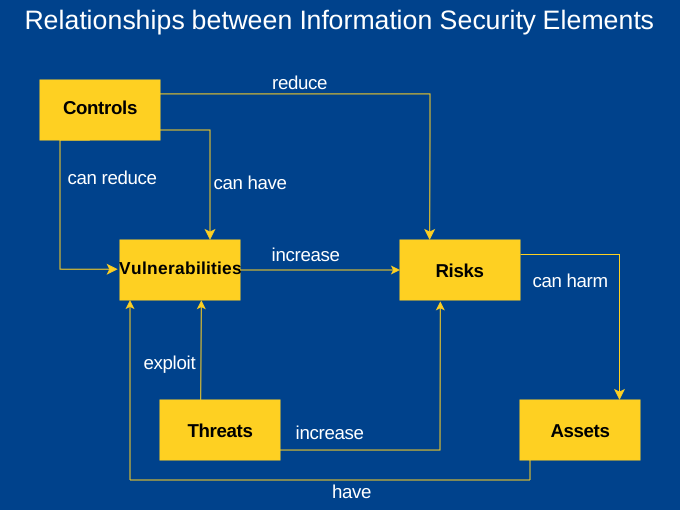
This relationship-based view is important because information security is not just about buying security tools or writing policies. It is about understanding what the organization values, what could go wrong, where weaknesses exist, how unwanted events might occur, and what can be done to reduce the likelihood or impact of harm. When these core elements are understood properly, security becomes less abstract and more operational. Organizations can begin to see why some risks are more important than others, why some controls matter more than others, and why an ISMS provides a structured framework for making those decisions. ISO/IEC 27003 emphasizes that an ISMS gives importance to understanding the organization’s needs, assessing information security risks, implementing controls and other measures to treat those risks, monitoring performance and effectiveness, and practising continual improvement.
Assets are the foundation of the discussion
Every meaningful discussion about information security starts with assets. ISO/IEC 27002 defines an asset as anything that has value to the organization. In the context of information security, this can include primary assets such as information, business processes, and activities, as well as supporting assets such as hardware, software, networks, personnel, facilities, and the organization’s structure. This means assets are not limited to servers and laptops. Assets also include customer data, financial records, contracts, systems, knowledge held by staff, operational workflows, and services the organization depends on every day.
This matters because assets are what an organization is ultimately trying to protect. Without understanding its assets, an organization cannot sensibly assess risk, determine control needs, or prioritize protection efforts. ISO/IEC 27002 recognizes this directly by including inventory of information and other associated assets as a control area and by recommending that inventories are developed, maintained, kept up to date, and linked to ownership. In other words, before an organization can manage security well, it needs a clear view of what exists, what matters, and who is responsible.
Assets have vulnerabilities
Once assets are identified, the next question is where they are weak. ISO/IEC 27002 and ISO/IEC 27000 define a vulnerability as a weakness of an asset or control that can be exploited by one or more threats. This is one of the most important definitions in the whole information security vocabulary because it explains why assets alone are not enough to create risk. Risk emerges when something valuable also has weaknesses that can be targeted, abused, triggered, or otherwise taken advantage of.
Vulnerabilities are not just technical. An unpatched system sits alongside weak access management, poor staff awareness, unclear responsibilities, missing backup tests, insufficient supplier oversight, and sloppy information classification as real risks to any organization. Take a payroll system: it might be perfectly maintained from a technical standpoint, yet still be highly exposed if too many people have access to it, if access rights are rarely reviewed, or if authentication practices are lax. Even something as intangible as a critical process that only one person truly understands counts as a vulnerability. The standards themselves reflect this broader view, deliberately accounting for weaknesses across people, processes, physical environments, and technology, not just software flaws.
Threats exploit vulnerabilities
Threats are another core part of the picture. ISO/IEC 27000 defines a threat as a potential cause of an unwanted incident which can result in harm to a system or organization. Threats can be malicious, accidental, or environmental. They can include attackers, phishing attempts, insider misuse, human error, power failures, equipment malfunction, fire, flood, supplier failure, and many other causes of unwanted events. ISO/IEC 27000 also explains that all information held and processed by an organization is subject to threats of attack, error, and nature, and subject to vulnerabilities inherent in its use.
A threat by itself does not automatically cause damage. It becomes dangerous when it can exploit a vulnerability. This is where the relationship becomes very practical. A malicious actor may exist, but if systems are well configured, access is tightly controlled, and staff recognize suspicious activity, the threat has fewer opportunities to succeed. On the other hand, even a basic phishing attempt can become highly dangerous when users are not trained, authentication is weak, monitoring is poor, and privileged access is not well controlled. The threat is the potential cause, but the vulnerability is often the door through which harm enters.
This is also why ISO/IEC 27002 includes threat intelligence as a control topic. The standard states that information relating to information security threats should be collected and analysed to produce threat intelligence, and that this intelligence should be used as input into risk management processes and technical preventive and detective controls. In other words, organizations are expected not just to react blindly, but to understand the threat environment relevant to them.
Vulnerabilities increase risks
Information security risk is understood as the potential for threats to exploit vulnerabilities in an information asset or group of assets, resulting in harm to the organization. This makes the relationship between vulnerabilities and risk very direct. Vulnerabilities increase risk because they make it easier for threats to succeed, and in some cases, they also amplify the consequences when something does go wrong.
Risk itself can be expressed more formally as the effect of uncertainty on objectives. In the context of information security, this means the effect of uncertainty on information security objectives specifically. That may sound abstract, but the practical meaning is straightforward. A risk exists when uncertainty around threats, weaknesses, and possible consequences could negatively affect confidentiality, integrity, or availability. If confidential data is stored on a poorly secured platform, that’s a risk. If system recovery depends on backups that have never been tested, that’s a risk. If key operational knowledge is not documented and exists only in one person's memory, that too is also a risk.
This is precisely why vulnerabilities deserve serious attention within any ISMS. They are not merely imperfections or oversights. They are conditions that directly influence the likelihood of unwanted events and can make their consequences significantly more severe. The more exposed, significant, or poorly managed a vulnerability is, the greater the chance that the associated risk will require treatment. Understanding this connection is fundamental to managing information security in a meaningful and structured way.
Risks can harm assets
Risks are not just theoretical concepts. They represent the possibility of real harm to information and other associated assets, and to the organization’s operations more broadly. ISO/IEC 27000:2018 defines an information security incident as a single or series of unwanted or unexpected information security events that have a significant probability of compromising business operations and threatening information security. ISO/IEC 27002:2022 complements this by highlighting the need to protect the availability of information and other associated assets during disruption and to prevent loss, damage, compromise, or operational interruption. Together, these standards make clear that information security risks can have direct consequences for information, systems, services, and business continuity.
Harm can take many forms. Confidential information may be disclosed to unauthorized persons. Data may be altered or corrupted, undermining integrity. Systems may become unavailable, affecting operations and service delivery. Records may be lost, supplier services may fail, or decision making may be disrupted because accurate information is no longer available when needed. Financial losses, regulatory consequences, legal exposure, and reputational damage often follow from these primary impacts. All of this is why asset identification and risk understanding are inseparable. Organizations do not assess risk for its own sake. They assess risk because risks can harm assets that matter to them.
Controls reduce risks
If assets, vulnerabilities, threats, and risks describe the problem space, then controls describe much of the response. ISO/IEC 27002:2022 defines a control as a measure that modifies or maintains risk, and explains that controls can include policies, rules, processes, procedures, organizational structures, and software and hardware functions. This highlights an important point, effective information security depends not only on technical safeguards, but on a broader set of measures across the organization.
This definition is broad for a reason. Controls are not only technical safeguards. A firewall is a control, but so is an access control policy, a supplier security requirement, an awareness programme, a backup process, an incident response plan, a secure development practice, an asset inventory, and a documented review process. This is consistent with ISO/IEC 27002, which explains that information security is achieved by implementing a suitable set of controls and notes that the level of security achievable through technological measures alone is limited unless supported by appropriate management activities and organizational processes.
Controls reduce risks in different ways. Some reduce likelihood by preventing threats from succeeding. Some reduce consequences by limiting damage or speeding recovery. Some improve detection, allowing a faster response when incidents occur. Some improve governance, ensuring that responsibilities, reviews, and decisions are more effective over time. A strong authentication mechanism may reduce the likelihood of unauthorized access. Logging and monitoring can improve detection. Tested backups can reduce the impact of ransomware or system failure. Supplier due diligence can reduce risks introduced by external parties. Security awareness can reduce the success rate of phishing and social engineering. In each case, the control is there to modify the risk in a meaningful way.
Controls can have vulnerabilities
One of the most important and often overlooked points in the standards is that controls themselves can have vulnerabilities. ISO/IEC 27002 is explicit that a vulnerability can be a weakness of an asset or control. This means organizations should never assume that the existence of a control automatically means protection is effective. A control can be present and still be weak, incomplete, outdated, misunderstood, poorly configured, inconsistently performed, or unsupported by the wider system around it. This is a very practical issue.
A policy that no one reads is a vulnerable control. Poorly configured firewalls are vulnerable controls. User awareness campaigns that employees do not understand are vulnerable controls. A monitoring tool that never generates alerts is a vulnerable control. The list goes on and on. While an organization with these types of vulnerable controls may look good on paper, in practice they would remain quite exploitable.
This is exactly why the standard goes beyond simply mandating the implementation of controls. It also requires organizations to establish, implement, maintain, and continually improve the ISMS, as well as monitoring and measure the controls they have implemented. Organizations are also required to conduct internal audits and perform management reviews to address nonconformities and take corrective actions to address them as necessary. To that end the standard is concerned with effectiveness, and not just checking a block on an audit report. Controls must be selected, implemented, operated, reviewed, and improved over time.
Controls can reduce vulnerabilities
Controls not only reduce risks directly, but as previously mentioned, they can also reduce vulnerabilities. This relationship is equally important, since vulnerabilities are weaknesses that threats can exploit. Many controls are specifically designed to remove those weaknesses, contain them, or reduce the chance that they can be abused. This is visible throughout ISO/IEC 27002. Controls around asset inventory, access control, identity management, authentication, technical vulnerability management, configuration management, awareness, supplier security, backup, and incident management all help reduce specific types of weakness.
For example, patching reduces known software weaknesses. Secure configuration of software, can reduce vulnerabilities due to misconfiguration. Access control and access rights reviews reduce exposure. Awareness and training reduce human weaknesses. Information classification and labelling improve handling and protection of sensitive information. Supplier relationship controls reduce vulnerabilities introduced through third parties. Backup and redundancy reduce the vulnerability of availability to disruption. Threat intelligence helps identify relevant weaknesses and attack patterns earlier, which supports better treatment decisions.
This point matters because some organizations think about controls only after incidents occur. In reality, many controls should be used proactively to reduce exploitable weakness before a threat actor, accident, or environmental event can take advantage of it. Controls are not merely reaction tools, they are also preventive tools that reduce vulnerability and strengthen resilience.
Threats increase risks
Threats increase risk because they raise the realistic possibility that a vulnerability may actually be exploited. Not every weakness is equally urgent. A vulnerability in a system that is never exposed, never used in a relevant way, and not connected to likely threat activity may still matter, but perhaps not as much as one that is actively targeted. Threat context changes risk context. This is one reason why ISO/IEC 27002 includes control guidance on threat intelligence and expects organizations to collect and analyse information related to information security threats.
An emerging phishing campaign in the sector, exploitation of a software flaw in similar organizations, or increasing supplier compromise incidents can all raise the risk level associated with existing weaknesses. The threat may be external, internal, accidental, or environmental, but in each case, it adds weight to the risk equation. Understanding threats helps organizations avoid a static view of security. Threats change, technologies change, business models change, and therefore risks change as well. Effective information security management requires that the organization notices this and adjusts accordingly. ISO/IEC 27001 specifically notes that organizations need to monitor and evaluate the effectiveness of implemented controls and procedures, identify emerging risks to be treated, and select, implement, and improve appropriate controls as needed.
How an effective ISMS helps connect all of this
This is exactly where an effective ISMS becomes so valuable. ISO/IEC 27001 states that organizations shall establish, implement, maintain, and continually improve an ISMS, including the processes needed and their interactions. It also requires the organization to determine internal and external issues, understand interested party requirements, define scope, assign responsibilities, assess information security risks, treat those risks, monitor and measure performance, conduct internal audits, perform management reviews, and improve continually.
An ISMS helps because it creates structure around relationships that would otherwise be handled in an ad hoc way. Instead of reacting randomly to incidents or applying controls without a clear rationale, the organization uses a repeatable method. It identifies assets, examines vulnerabilities, considers threats, assesses risks, and determines appropriate treatment. ISO/IEC 27000 describes an ISMS as a systematic approach for establishing, implementing, operating, monitoring, reviewing, maintaining, and improving an organization’s information security, based on risk assessment and risk acceptance levels designed to effectively treat and manage risks.
ISO/IEC 27003 reinforces this by explaining that an ISMS emphasizes understanding the organization’s needs, assessing risks related to information security, implementing and operating controls and other measures to treat risks, monitoring and reviewing the performance and effectiveness of the ISMS, and practising continual improvement. It also highlights key components such as policy, persons with defined responsibilities, management processes, documented information, information security risk assessment, and information security risk treatment.
In practical terms, an effective ISMS helps organizations identify assets more clearly, recognize vulnerabilities earlier, understand threats more accurately, and evaluate risk more consistently. It also helps expose weaknesses in existing controls. That matters because many organizations are not primarily lacking controls, they are lacking clarity, consistency, ownership, review, and continual improvement. An ISMS addresses those issues by making information security part of management practice rather than an isolated technical function. ISO/IEC 27001 also states that the ISMS should be part of and integrated with the organization’s processes and overall management structure, and that information security should be considered in the design of processes, information systems, and controls.
Bringing the relationships together
The relationships between the core information security elements should now therefore be more clearly understood.
Assets are things of value to the organization. Assets have vulnerabilities, meaning they contain or depend on weaknesses. Threats are potential causes of unwanted incidents and can exploit those vulnerabilities. When threats can exploit vulnerabilities, risks increase. Those risks can lead to harm to assets, whether through loss of confidentiality, integrity, or availability, or through wider operational, financial, legal, or reputational consequences. Controls are the measures used to maintain or modify risk. Controls can reduce risks directly, and they can also reduce vulnerabilities by removing or limiting weakness. At the same time, controls themselves can have vulnerabilities, which means they also need review, testing, monitoring, and improvement.
This model is one of the reasons the ISO 27000 family remains so useful. It turns complex security language into a management framework that organizations can actually apply. Rather than chasing isolated issues, the organization can understand how the pieces fit together and make better decisions about what to protect, what to prioritize, what to improve, and what to monitor over time.
Next steps
If you want to reduce risks, threats, and vulnerabilities affecting your organization’s assets, start by taking a structured view of what you actually depend on. Identify your information and associated assets. Understand where weaknesses exist. Consider which threats are relevant to your business, sector, environment, and operating model. Assess the risks that arise from those relationships, and then determine and implement controls that are appropriate, proportionate, and effective. Review those controls regularly, because a control that is not maintained, measured, or improved, as mentioned above, can become a weakness itself.
An effective ISMS provides the framework to do this properly. It helps organizations move from reactive decisions and disconnected safeguards to a coherent, risk based, and repeatable approach. Begin with asset identification, risk assessment, and thoughtful control selection. Build from there through clear ownership, governance, awareness, monitoring, testing, and continual improvement. That is how organizations reduce uncertainty, strengthen resilience, and protect what matters most.